Weekly Ishi 23 September 2026
Weekly Ishi 14: The Ishi Card
Grit, situation and self-governance
The one artefact
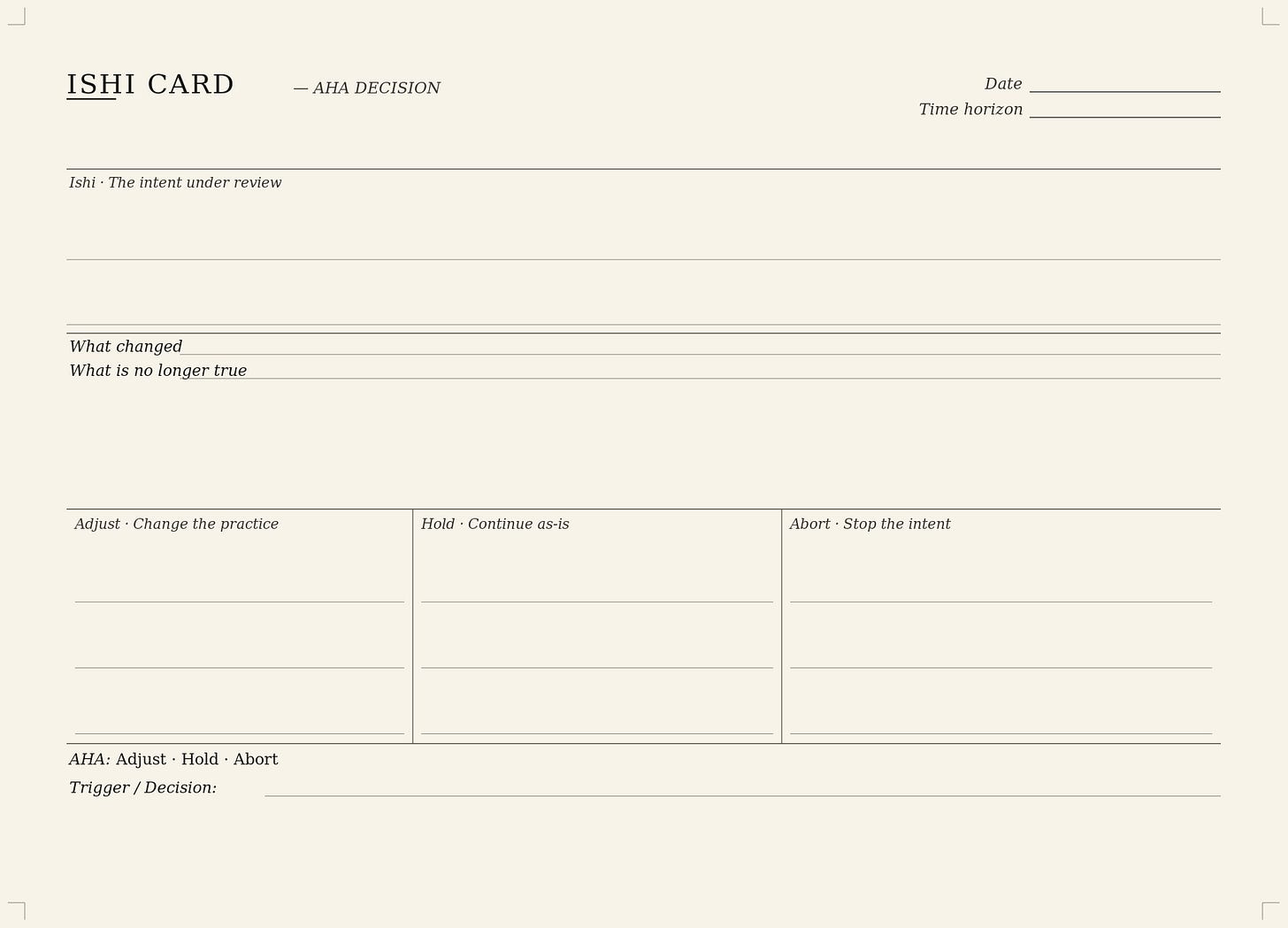
The Ishi Card is the single non-negotiable artefact of the discipline. It holds the intent, the time horizon, the boundaries, the AHA triggers and a record of what was actually done. Once your intent is on the Card, the work stops being hypothetical and you finally have something to govern yourself with. I write one every day.
Ishi runs through 4 phases: Decide, Forge, Persist and Reflect, or Ishi (意志), Shugyo (修行), Gaman (我慢) and Hansei (反省). The Card establishes the constraints during Shugyo and Gaman and provides the anchor for Hansei.
One card, any horizon
At its smallest, the Card is the Minimum Viable Ishi. Take an index card, write today’s date at the top and, beneath it, one intent for the day in one sentence. It takes 30 seconds. The same card can hold the objective of a single 90-minute sprint, a session of focused work that begins with written intent and ends with reflection. With more detail it can govern a week, a month, a quarter, a season or a year.
I nest my horizons. A single day operates as a complete small Spiral: one Ishi Card, one focused session, one stretch of governed effort, one evening review. That day is part of a weekly Spiral, and the Hansei of the smaller Spiral often forms the Ishi of the larger one. Monthly, seasonal and annual intent is expressed mostly as outcomes, because specific actions cannot survive that much uncertainty.

Written by hand
I always write the Card by hand. Typing allows endless revision without commitment. Handwriting forces explicit confirmation of the decision, and it is slower, which is precisely why it works. The friction is the mechanism.
Britain’s National Health Service has tested interventions to reduce missed appointments. In one Bedfordshire trial, patients wrote the appointment time and date on the appointment card by hand rather than receiving a filled card. Non-attendance fell sharply, by roughly 18% versus the prior baseline (Martin, Bassi and Dunbar-Rees, Journal of the Royal Society of Medicine, 2012). Writing forces a pause and a small act of ownership. Intent passes through the hand and becomes harder to shrug off later.

Grit, situation and self-governance
In the past week I read Angela Duckworth’s Situated. Her first book, Grit, is one of the 10 influential reads I wrote about in the appendix of my book, Ishi: The Discipline of Determined Intent. In Situated she argues that grit is important, but situation is necessary, and that setting the right environment is more important than willpower alone. I agree.
In my own work on Ishi, self-governance is another piece of the puzzle. The Ishi Card is a governance artefact, written so the present you can govern the future you. Articulating the intent and capturing it on the card effectively constrains the future you.
How the Ishi Card works
First, set the intent. State it in one sentence on one card, bounded by time and protected by explicit exclusions. On the Card you are effectively deciding what you will say no to.
Second, declare the first move. The Card forces a first step that is small enough to start and specific enough to count, and that first move creates the activation energy for the work. Aim for traction with so little cognitive inertia or static friction that you cannot rationalise your way out of starting. In Turn the Ship Around!, L. David Marquet names one of his mechanisms “Act your way to new thinking.” The first move is where that begins.
Third, describe the intended outcome, the learning and the deliberate practice. Intent specifies the action to be taken and the outcome being sought, while keeping action and outcome distinct for later review. Shugyo goes on the Card as a single repeatable action, defined in behavioural terms: what will be practised, when it will occur and what constitutes completion.
Fourth, pre-write the Hansei questions as prospective hindsight. I give my future self the questions he would ask of my current self about the quality of the decision. Was the decision sound given what was known at the time? Were the constraints clear or assumed? Did the intent reflect purpose or ego?

Overcoming bias in Hansei
Hansei is reflection at distance, undertaken after motion has ceased and emotion has cooled enough to see clearly. Its first task is to separate decision quality from outcome quality. When you reach Hansei, the Card is how you overcome hindsight bias and self-justification. History cannot be rewritten. You have to look at what you actually decided.
Annie Duke calls the trap resulting: judging a decision by its outcome rather than by what was knowable when the decision was made. In Thinking in Bets she dismantles the comforting illusion that good outcomes prove good decisions. A sound decision can produce a poor result when uncertainty intervenes. Luck or timing can make a flawed decision succeed.
Hansei uses psychological distancing to break that grip by stepping out of the first-person narrative. Construal Level Theory, developed by the psychologists Yaakov Trope and Nira Liberman, shows that proximity in time, space or identity narrows thinking. When the self is fully embedded in the moment, cognition becomes concrete, emotional and defensive. L. David Marquet and Michael Gillespie formalised stepping back as a self-leadership practice in Distancing: How Great Leaders Reframe to Make Better Decisions. In Distancing, authority over action depends on the ability to step back from it. Temporal distance asks what this decision will look like in 6 months instead of 6 minutes.
I first read about prospective hindsight in Stephen Denning’s The Leader’s Guide to Radical Management, about 10 years ago. Imagining that an outcome has already happened, and then explaining why, increases the reasons generated by about 30% (Mitchell, Russo and Pennington, Journal of Behavioral Decision Making, 1989). Pre-written questions put that distance on the Card while judgement is clear and before identity becomes entangled with effort.

The Card, step by step
The work begins with one index card and one pen. State the intent clearly enough to fit on an index card and constrain it with time. Name what you will pursue and what you will pause to make room for it. Define one practice, small, repeatable and anchored to something stable in your day. Schedule the first action.
Set your boundaries before persistence is tested. Write your AHA triggers on the Card now: fatigue thresholds, boundaries and time limits, the conditions under which you will Adjust, Hold or Abort. Adjust changes the method. Hold continues within the original boundary. Abort exits when the conditions that authorised effort no longer hold. Close the Card with the Hansei date and the questions for your future self.
The Card is written once and remains unmodified until Hansei. When motivation wavers or doubt appears, the Card is consulted rather than renegotiated. It captures the intent, constraints, exclusions and abort conditions as understood at the moment of decision.
When the horizon closes, return to what you actually wrote when judgement was clear and assess the decision separately from the outcome. Declare the verdict for the next horizon: Recommit, Pivot or Release. If no single change is declared, Hansei did not occur.
Grit and deliberate practice
Duckworth pairs grit with deliberate practice. Grit shows that gritty performers rely on consistent structured practice: deliberately training, seeking feedback and returning to the task daily. In Situated she mentions a short film on deliberate practice that she co-wrote with Anders Ericsson, narrated by the jazz trumpeter Wynton Marsalis. I like it. It runs for 60 seconds at
I see Forge and Persist, Shugyo and Gaman, as a pair in the Ishi Spiral that reinforce one another. The quality of practice changes the character of persistence. Gaman endured under poor form is grinding. Under refined form, it is composure. Shugyo makes the difference. And the quality of persistence changes what practice is available next.
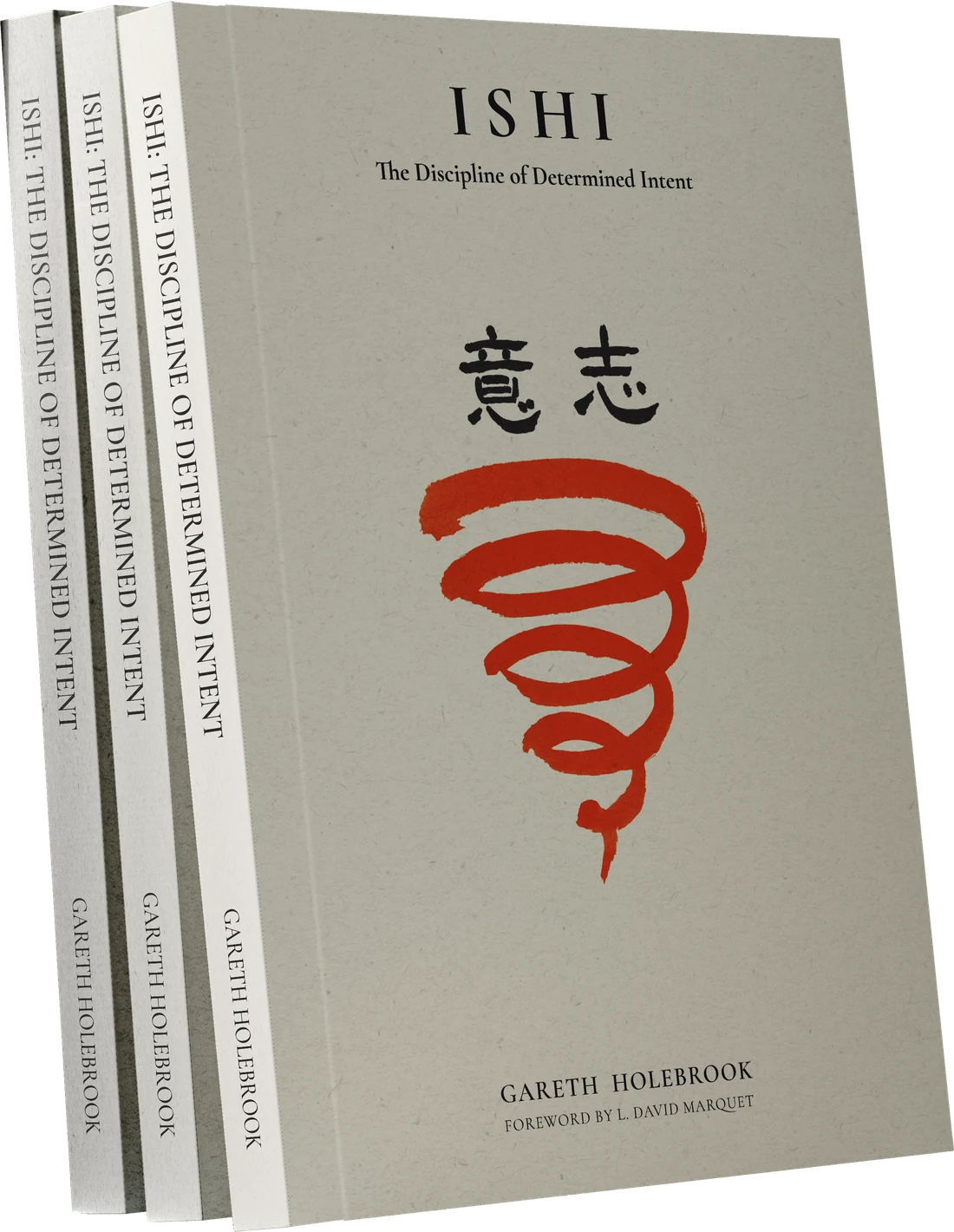
The full system is in Ishi: The Discipline of Determined Intent on Leanpub at https://leanpub.com/ishidodi and on Amazon in paperback and Kindle.
First published on Substack: read Weekly Ishi 14: The Ishi Card on Substack.