Weekly Ishi 29 September 2026
Weekly Ishi 15: Persistence over the Long Arc
Endurance held in proportion, and the 2 ways it fails

Last Saturday I ran part of an ultramarathon with Shannon-Leigh Litt. She started the day at parkrun, then kept going for another 46km. It was day 1,000 of a streak she began on 1 January 2024: at least 51km every day, through floods, heat, cold and illness. Her early runs took about 6 hours. By the end, each took closer to 8. She let the pace slow and kept the distance. Her rules were set before day 1, from the distance to the time zone to the food she ate, and she stopped on the day she said she would. I have written her story in full in a separate article, linked here:
https://ishidodi.substack.com/p/shannon-leigh-litt This week I want to use it to look at persistence itself.
Persist is the third phase of the Ishi Spiral. The Japanese name is Gaman, and I read it as endurance held in proportion. The phases in order are Decide (Ishi), Forge (Shugyo), Persist (Gaman) and Reflect (Hansei). Persist is where a decision meets time. Novelty fades, progress slows and the work keeps asking for effort long after the reasons for it have stopped feeling fresh. Every endeavour measured in years passes through this phase: a business, a book, a career change, a training block. It is also where I have made my most expensive mistakes, in both directions.
Continuing too long
In January 2004 I raced a Half Ironman in Auckland where BodyO₂, an altitude training franchise, was the naming sponsor. After the race I asked whether it planned to open in Christchurch. The franchisor said no, but mentioned he was looking for franchisees. I bought a coffee, thought about it for 10 minutes and went back for a business card. By April I had resigned from Navman and opened the doors.
Within 3 months people were coming in, mostly on free sessions I had given away as sponsorship prizes. By September the cash flow had gone. In February 2005, a week before Coast to Coast, the bank withdrew my credit line. I was insolvent. I raced anyway, and I kept the business going for another 5 years under my own brand, PerformO. By the time I closed it after the global financial crisis, I had lost the best part of a million New Zealand dollars.
The signals were visible within months. I ignored every one of those signals because stopping felt like weakness. Endurance had become my identity, and identity blocked perception. Barry Staw described this pattern in 1976. In his experiment, the people who had personally made a decision and then watched it fail committed the most money to it afterwards. I did exactly that, for 5 years.
Ten years later I did it again with my body. In 2014 I raced Ironman New Zealand in March and Ironman Cairns in June. I flew to Edmonton for the triathlon world championships, entered the Olympic distance and then added the sprint and the aquathlon because I could. The following week I raced Powerman Zofingen in Switzerland. I set personal bests at both. Back home I went straight into a club training camp and felt empty for the whole week. Two weeks later I had shingles. I pulled out of the Coast to Coast and did not race for almost a year.
My coach, Stephen Farrell, told me to stand in front of the mirror and ask why the conditions were there for it to take hold. Nothing had gone wrong suddenly. I had stacked demand onto a system with no enforced recovery and no permission to stop. I was run-down long before anything broke down. My body made the call my judgement had refused to make.
Stopping too early
The opposite failure is harder to see from the outside and just as costly. Effort ends before practice has had time to compound, and the work is abandoned at the point where the investment was about to start paying back. Discomfort gets read as danger, doubt as evidence and difficulty as a sign the whole thing was a mistake.
Endurance science helps here. Tim Noakes proposed the central governor model, in which the brain regulates effort to protect the body, well before any real limit is reached. Samuele Marcora offers a competing account built on perceived effort. The 2 models disagree on mechanism, and I use both as metaphor. Both agree that the feeling of having reached your limit is partly constructed by the mind, and that the signal can be interpreted before it is obeyed.
On day 2 of Kiwiman, everything in my body wanted to stop. The logic for stopping was easy to assemble. I held. The signal was discomfort, and nothing was damaged. The race was also part of a larger decision, to write my book, and walking away mid-course was a cost I had already decided I would not pay.
Governing the phase
Persistence and judgement are separate skills, and under load I had only one working. Persistence answers whether you can continue. Judgement answers whether continuing still makes sense. Fatigue degrades judgement first, so it needs protecting before the effort starts.
That is the job of AHA: Adjust, Hold, Abort. Adjust keeps the commitment and changes the method: pace, load, technique or environment. In racing it is the response I use most. A pace that made sense at 10 kilometres no longer holds at 30, so the pace changes and the objective stays. In the seasons when I raced best, the pattern was how early I adjusted. I modified sessions before I was at risk of injury, and the method never became sacred. Hold keeps the load when the signal is discomfort. Abort ends the commitment before continuing costs more than it is worth. The thresholds for each are set in the Decide phase, while judgement is clear and identity has not yet attached itself to the effort. By the time I need AHA, my capacity to reason has already degraded. The mechanism has to be in place in advance.
Persist also needs a horizon. Endurance without an end date erodes judgement, because the system forgets that continuation was conditional and starts to treat it as absolute. BodyO₂ had no end date and no abort condition. My 2014 season had no recovery written into it. In both cases I had discipline without self-governance.
Equilibrium
Running beside Shannon-Leigh, I saw the phase working as designed. She knows how to run fast. She has run a half marathon in under 90 minutes, and chasing that kind of speed at any point in the last 3 years would likely have ended the streak. She chose a pace she could hold for 1,000 days. The end date was set on day 1. The rules about distance, time and fuel were decided before she ever needed to rely on those rules. When illness hit, including a spell she told me about in Thailand, she adjusted the pace and held the commitment. When day 1,000 came, she stopped. The streak ended exactly where the decision said it would, with nothing left to renegotiate.
That is Gaman: endurance held in proportion, bounded by a decision made while her judgement was clear and released when the horizon came.
What are you persisting with right now, and when did you last decide it still deserves your effort?
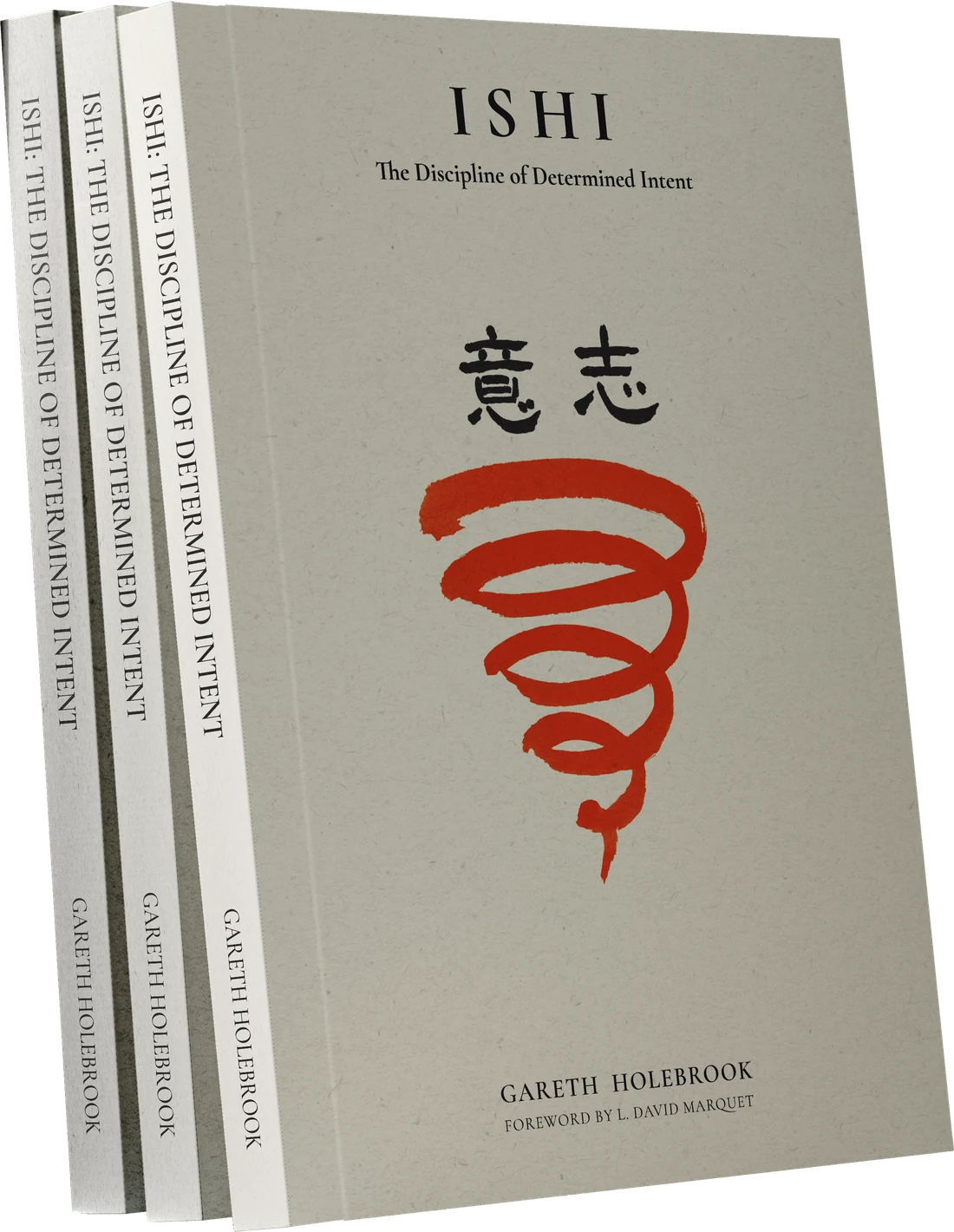
Ishi: The Discipline of Determined Intent sets out the Spiral and AHA in full.
Leanpub: https://leanpub.com/ishidodi
Amazon paperback: https://www.amazon.com/dp/1067285512
Amazon Kindle: https://www.amazon.com/dp/B0H4HV95PC
First published on Substack: read Weekly Ishi 15: Persistence over the Long Arc on Substack.