Weekly Ishi 30 October 2026
Weekly Ishi 20: A 'Yes' That Can Hold
Ishi Weekly Digest. October 30 2026.
At 9:30 a.m. on race morning at Ironman New Zealand in March 2017, I pulled out. I ordered a big breakfast at a café near the start, changed out of my trisuit and went back to the venue to volunteer in the second transition tent, checking athletes for dehydration and cold on a windy day.
Two resolutions came out of that morning. On the day I resolved to swim Cook Strait and beat my seasickness. After it I locked in Powerman Zofingen in Switzerland that September, the Long Distance Duathlon World Championships, and signed up and trained for it.
Of the Cook Strait swim I wrote in my book, “That Ishi remains open. Maybe one day.” Both were things I wanted, and only one changed what I did the following Tuesday. This week’s 5 articles were about the difference.
How the week ended
On Thursday a podcast I recorded in September came out. On Product Pals: Beyond the Build, Charlotte and Kiet asked me how to make a good decision, and we talked about what happens to a decision after it is made. I watched it back and I am happy with it. It comes at my work from a different angle, for people who build products.
It was also the second week of Ishi in Practice, the series of articles for paid subscribers that runs each weekday until Christmas. Last week covered the whole Spiral. This week stayed with the first phase, Ishi, and with what a yes needs before the pressure starts: its costs, its edges, its critical moments settled in advance and a record that someone else could read back.
Your one decision this week
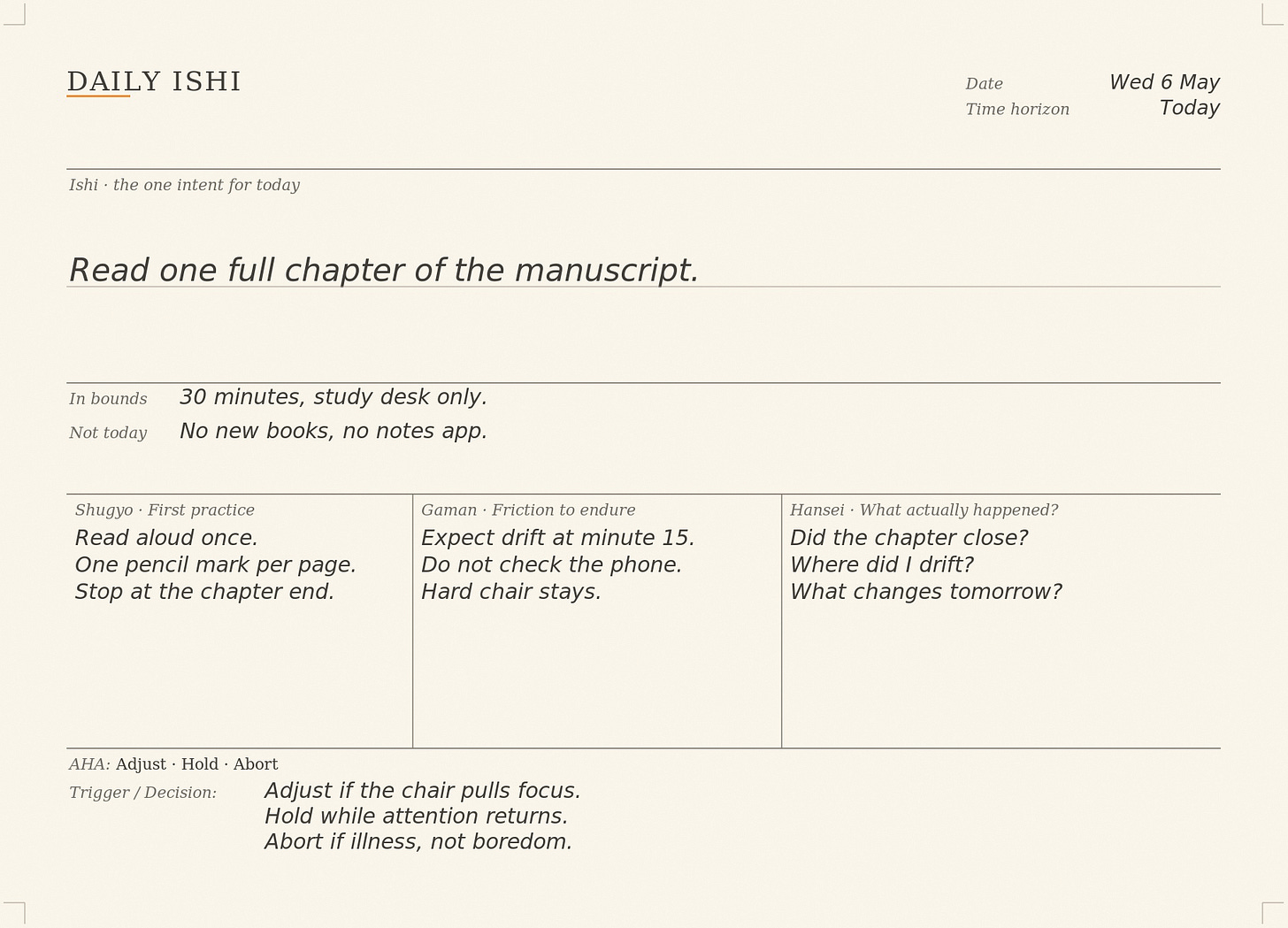
Take the card you wrote last week, or the plan you are running now, and read one line of it aloud. Ask whether someone else could act on that line at the moment it is needed, without asking you what you meant.
A line that leans on “about”, “when I can” or “if needed” is still closer to a wish than a decision. Rewrite it with a time, a situation and a response, and write under it one thing the yes says no to.
The 5 articles
Monday’s One Signed Up, One Still Open tests those 2 resolutions against the 6 elements my book says a decision needs before it constrains anything. Zofingen passes most of the test, and the Cook Strait swim meets one element.
On Tuesday, What Does Your ‘Yes’ Say ‘No’ To? follows a naval apprenticeship of yeses that cost me my exam results, a Kona build written as a trade and a black belt exam that kept moving. It shows how to put the costs on the card without shrinking the ambition.
Wednesday’s Illness, Not Boredom works through the boundaries a decision can hold, on the example Daily Ishi in my book. Its last line, “Abort if there’s illness, not for boredom”, names the reason that does not count, and the article explains why that half of the line does so much work.
Decide the Moment in Advance, on Thursday, starts from a card written at 8:55 one morning in January. It sets what the research on if-then plans shows beside what Ishi does with it, and notes where that research is thinnest.
Today’s Read the Card Like a Stranger reads a completed card back against what happened, line by line. The card is from my 5-day fast in July, chosen because it has a published outcome to read it against, and the article finds the line I would rewrite.
The Spiral in a paragraph
The Spiral has 4 phases. Decide, or Ishi, sets the commitment, its horizon and the conditions under which it ends. Forge, or Shugyo, turns the commitment into capability through practice that is corrected and repeated. Persist, or Gaman, holds effort steady under load, governed in flight by the AHA (pronounced A-Hey) responses, Adjust, Hold and Abort, declared in advance. Reflect, or Hansei, monitors while the work runs and reckons at the horizon, where the verdict is to recommit, pivot or release.
One observation from the week
A card’s most important line can be its least carefully written. The example Daily Ishi in my book ends on an abort line that names both the reason to stop and the reason that does not count. My card for the July fast said only “if I get sick, I abort”.
That left the threshold to whoever was fasting on the day, and by day 3 that person was hungry, sleeping badly and in the worst position to draw the line. The fast ran to its horizon without a stopping condition being met, and a stranger reading the card would have to take my word for it.
I invite you to read the 5 articles in full as a paid subscriber of Ishi, at https://ishidodi.substack.com
First published on Substack: read Weekly Ishi 20: A 'Yes' That Can Hold on Substack.