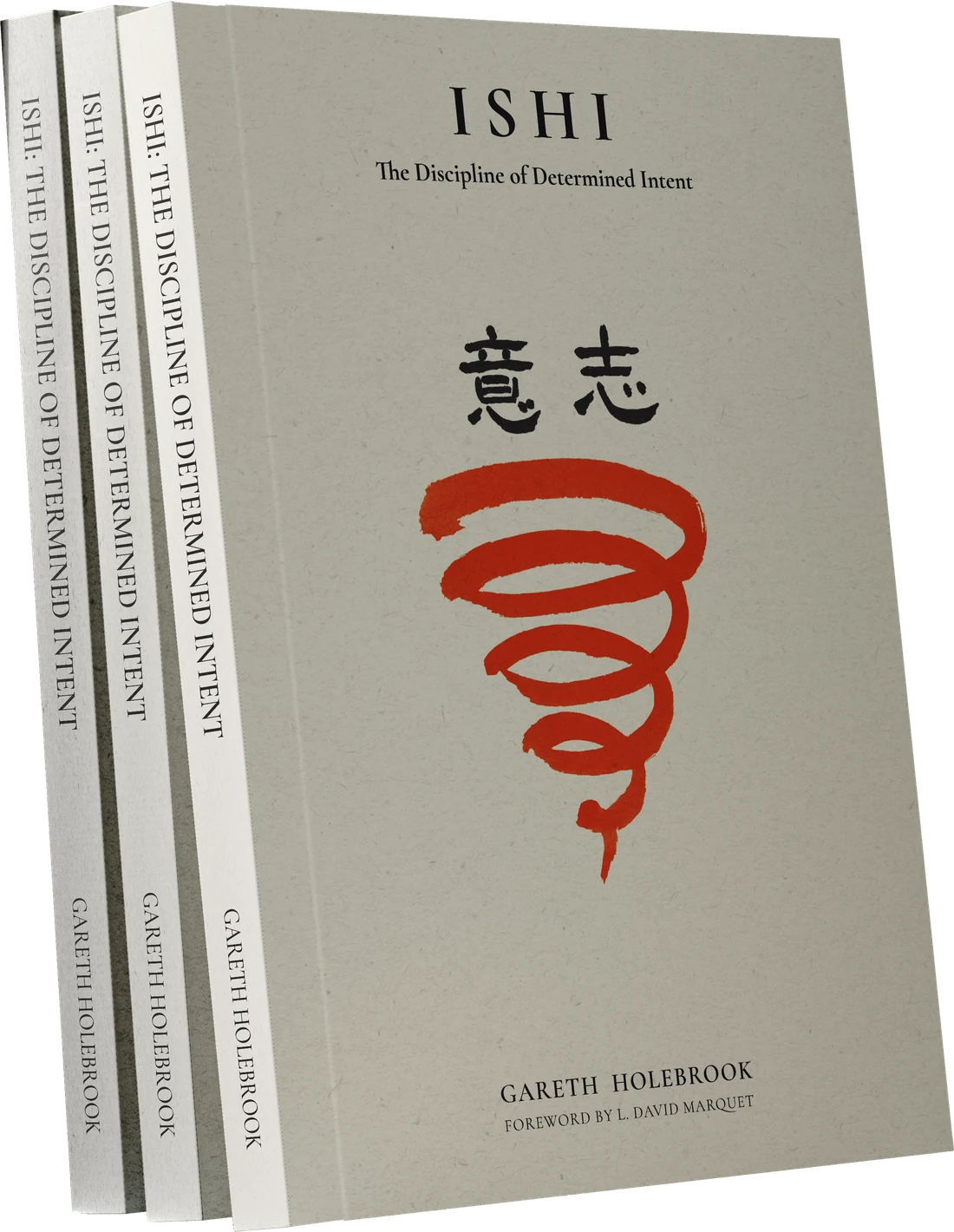
Weekly Ishi 9 July 2026
Weekly Ishi 4: Introducing the Ishi Card
Weekly Ishi 4
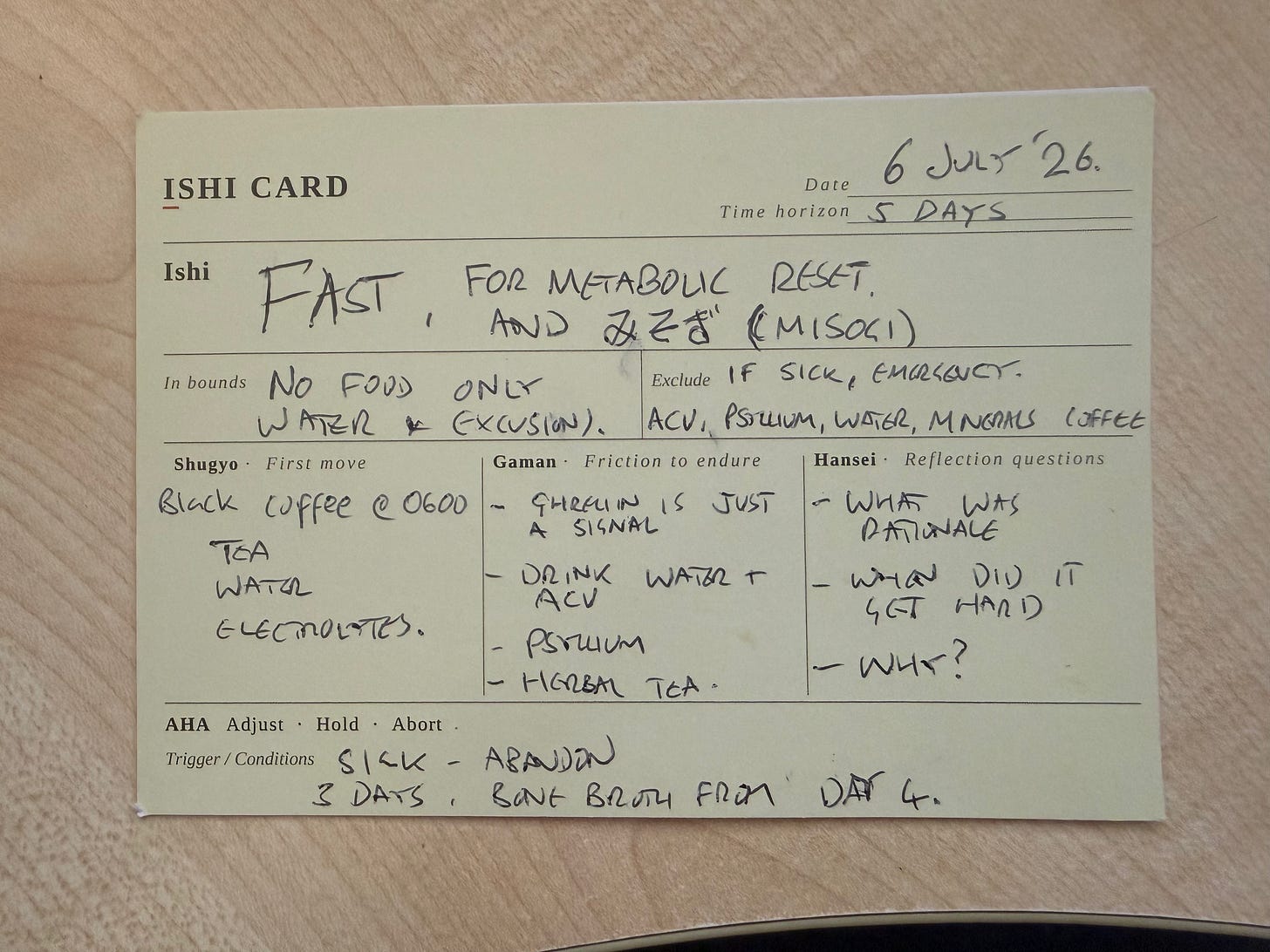
On the morning my 5-day fast began, I filled in a card before the first coffee. Date, intent, first move, the friction I expected and the line that would make me stop.
I wrote it at 0600 with a clear head, before hunger, fatigue, negotiation and drift started speaking. By day 3 all four of them speak, and they speak with your own voice. A card filled in on day 3 is filled in by the wrong version of you.
The fast is only the example. What I want to show you is the card, because the card is the instrument at the centre of Ishi.
Ishi is the discipline of determined intent. It is also a system, because its four phases, Decide, Forge, Persist and Reflect, feed one another rather than run in a straight line. What you learn in the work changes the decision you thought you had settled. The card is where all of that starts, on one page you can hold.
Before a reader reaches any of the theory in the book, in the author’s note right at the front, I ask for one thing. Write down an intent. One sentence. Today’s date. Thirty seconds. Most people skip it and start reading. The ones who stop and write have already begun the practice.
I lead with it because writing changes your relationship to a decision. Spoken intent stays soft. It edits itself as conditions change and later swears it never said otherwise. Written intent holds still. It gives the decision a visible form, keeps the work from staying vague and leaves a fixed point to return to when pressure starts negotiating. It also makes honest reflection possible, because you cannot reflect against a memory that has rewritten itself.
The NHS has tested this in the plainest possible setting. In a Bedfordshire trial, patients who wrote their own appointment time and date on the card, rather than being handed a filled one, missed fewer appointments. Non-attendance fell by roughly 18%. Writing forces a pause and a small act of ownership. Intent passes through the hand and becomes harder to shrug off later.
The Ishi Card is where that instruction becomes a practice you can hold in your hand. One card, handwritten, small enough to sit on a desk or in a pocket. Not a worksheet or an app. Digital text invites endless revision, and revision without commitment is how intent slips. Handwriting forces you to commit once, in ink. It is a governance device rather than a motivational one. Its job is to hold the decision still while the conditions around it change.
You have probably seen an intention card. Write down what you intend and you are more likely to do it. That is fair, and it works as far as it goes. The Ishi Card starts there and keeps going. It carries the intent and the reason behind it. Then the time horizon, so the commitment has a start and a review point. Then the first move, the concrete act that begins the work. Then the deliberate practice, the thing you will repeat and correct. Then the persistence strategy, how you will hold when it gets hard. Then the AHA triggers, the conditions under which you will Adjust, Hold or Abort. And then the Hansei questions, the questions your future self will ask of this decision. The difference is governance. An intention card records what you want. The Ishi Card governs what you do about it under load.
Here is the card I filled in for the fast, so the fields are concrete rather than abstract.
The intent was a 5-day fast, for a metabolic reset and as a hard thing chosen on purpose. The time horizon was 5 days, with a review at day 4. The first move was black coffee at 0600, then tea, water and electrolytes. Nothing else. The deliberate practice was to hold the same morning routine rather than decide again each day, because a decision made once holds better than a decision remade every morning under hunger. The persistence strategy was to treat hunger as information. Ghrelin rises in waves and it passes, so I hold the routine rather than renegotiate it. The AHA triggers were set before I started: if I get sick, I abort, and bone broth comes in from day 4 if I need to hold rather than stop. And the Hansei questions were written at the top, where I could not dodge them later: what was the rationale, when did it get hard and why.
That last field is the newest part of the discipline, and the one I want you to notice.
At the Decide phase you do not only set the intent. You also hand your future self the questions that will later test it. You write them before the work begins, while you are still honest, and you let them wait.
They do a specific job. When you are 3 days in and tired, the mind reaches for reasons to keep going that have nothing to do with the original decision. You have already started, so you feel you have to finish. The last hard hour feels like the whole picture. You notice only the evidence that says carry on. Preloaded questions interrupt that. They pull you back to the rationale you set when you had nothing yet invested.
They also separate the decision from the outcome. A good decision can end in a poor result, and a poor decision can get lucky. Annie Duke calls judging a decision by its result resulting. The Hansei questions, set in advance, are how you refuse to do it.
I give these cards out when I keynote. People fill them in during the talk, and some send me a photo weeks later with a line on what held and what broke. A few go out with signed copies of the book.
Now I want yours.
Download the Ishi Card. Fill one in for something real, a daily Ishi or a weekly one, and write the intent before the pressure starts speaking. Then post it or comment a photo of the filled card. Tag it #IshiCard.
I want to see how people actually use this. Not in theory. In practice. I will read them, and I will write more from what you send, from the Ishis people set and how the card holds when the conditions turn.
Download the Ishi Card here:
If the series is new to you, subscribe. Over the coming weeks it walks through the whole discipline, one phase at a time.
Write one Ishi. Post it. Tag it #IshiCard.
Reference: Martin, S. J., Bassi, S. and Dunbar-Rees, R. (2012). Commitments, norms and custard creams: a social influence approach to reducing did not attends (DNAs). Journal of the Royal Society of Medicine, 105(3), 101-104.
First published on Substack: read Weekly Ishi 4: Introducing the Ishi Card on Substack.