Weekly Ishi 19 August 2026
Weekly Ishi 10: Hansei
In January 2004 I raced my first Half Ironman in Auckland. An altitude training company called BodyO₂ was the naming sponsor, and afterwards, over a coffee at the finish line, I asked the team about opening in Christchurch, where I was living. The answer was no, though the rep mentioned he was looking for franchisees.
That coffee was the decision, and a rapid one too. One sentence, and I can still state it exactly: I want to set BodyO₂ up in Christchurch. Everything that followed was escalation from that sentence. By the end of March I had resigned from Navman. On 19 April I opened the doors.
The physiology was sound. Dr John Hellemans, one of New Zealand’s leading endurance coaches, used altitude exposure with the athletes he coached and advocated it openly. I still use the technique to this day. John also told me at the outset that the commercial model would not work. I heard him clearly, dismissed it and I pressed on regardless. Challenge accepted.
Over the following years the business took close to a million dollars off me. I was employing up to 6 people. A week before the 2005 Coast to Coast the bank reached the same conclusion Hellemans had reached at the start and pulled my credit lines, and I was insolvent, living on the energy biscuits I was selling from my own shop. I ended up as a contract Project Manager flying to China to pay for to keep the doors open.
I never went back to the first sentence. Not in the first year, when the numbers were already saying what Hellemans had said out loud, and not in the fifth. The decision was made once, over a coffee at a finish line, and after that it simply ran.
I told myself I was being resilient. I worked long hours, absorbed pressure and read difficulty as evidence the work was worth doing. Persistence had become a moral posture rather than a governed choice, and suffering became something to justify rather than interrogate. The failure was the absence of disciplined reflection, and the absence of the courage to withdraw once continuation no longer served the intent. Effort and ambition were never in short supply.
What Hansei is
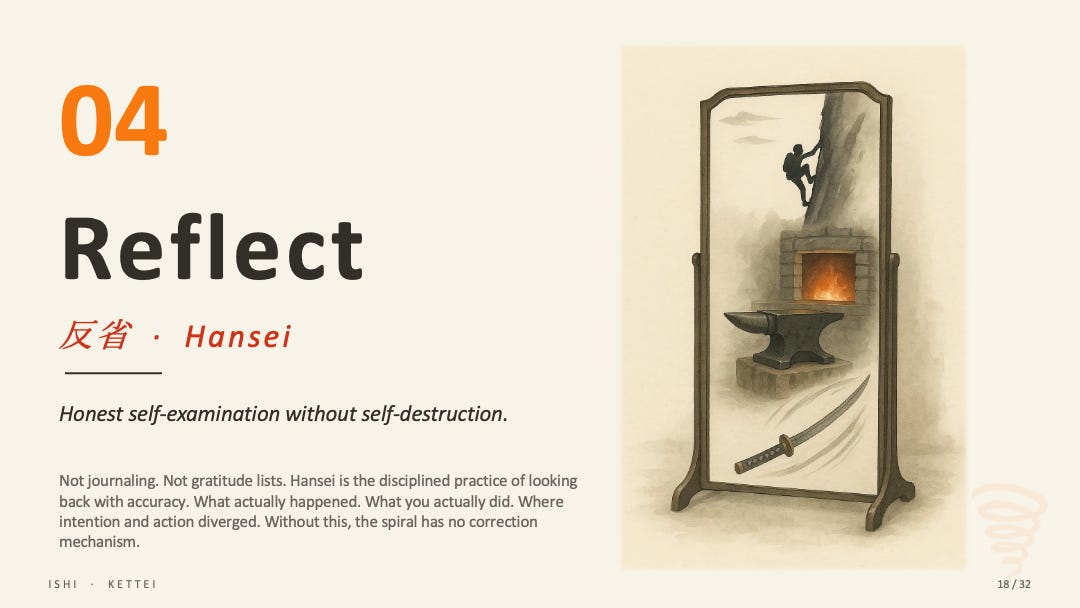
Hansei (反省) is the fourth phase of the Ishi Spiral, and it is the reflection that completes effort without defending it. The characters describe an action rather than a feeling. 反 means to turn back, to face what you have already done. 省 means to examine, to look closely and without distraction. Together the pair point to a disciplined movement of attention back towards your own choices, for the purpose of correction.
In English, reflection has softened into something you do in a journal. Hansei imposes an obligation. It asks whether the intent was honoured, whether the assumptions were valid, and whether judgement stayed intact under pressure. It asks why the thing seemed reasonable at the time, which is the question that determines whether the reasoning repeats.
Most reflection fails because it happens too close to the event. The self that acted is still the self doing the judging, and judgement collapses into justification. Emotion runs the interpretation, the story hardens, and learning gets replaced by explanation. Distance is what breaks that. Reflection without distance is rumination. Distance without reflection is avoidance. Put together the pair produce correction.
Write the question before you need it
I talked about this on the Forking good podcast recently (link at the bottom) and it is the part I would most want you to take away. Write the questions you will need at Hansei at the moment of the decision. The review is too late to invent a question, because by then you already know how the thing turned out and the knowing contaminates it. So when you set the intent, while your head is clear and nothing has yet gone wrong, ask yourself one thing and write the answer down.
What question will my future self ask of this moment?
That is the whole move. The man holding the coffee had one sentence and no question attached to it, and the question he needed was handed to him by an expert soon afterwards. Had he written it down at the finish line, in his own handwriting, the version of me years later with the credit lines gone would have had something to answer to besides his own pride.
At Hansei you ask more than that one question, and each of the additional ones is deliberately unflattering. Restate the original intent in its exact terms, with the boundaries, the abort triggers and the horizon exactly as written, so the review cannot drift into storytelling. Then separate the quality of the decision from the quality of the outcome, because a win will hide a bad decision for years and a loss will bury a good one. Ask what was controllable, what was contextual and what you simply misjudged. Ask what would be said about this if it belonged to somebody else entirely.
Then give a verdict for the next horizon. Recommit, pivot or release. Name one change. If no single change is declared, Hansei has not happened, and the honest response is to run it again over a shorter horizon.
Where this goes next
Everything above governs one person. Move the same failure into an organisation and it gets considerably worse, because the investment hardens into reputations and budget lines rather than into one man’s pride. Time, effort and standing accumulate until continuing feels safer than stopping, and by then nobody owns the authority to stop it. The literature calls it escalation of commitment and sunk cost. What I watched happen to my own business over 5 years happens to funded programmes at a scale where the person who made the original call has often moved on, and where no condition was ever recorded that would end it. I will talk more about this in my upcoming book, Kettei: The Discipline of Governed Intent.
The card
Tonight, before you sleep, take one commitment you are currently holding. Write down the intent as you originally set it. Write what the evidence now says. Write one breach, if there was one, and one change for the next cycle. Then give it a verdict.
It takes a couple of minutes and it is unpleasant in a way that a journal entry never is. That discomfort is the mechanism working. The Spiral only ascends when each turn earns the right to the next one.
Find out more:
Forking Good Podcast:
My book is available on Leanpub.com/ishidodi and amazon.com/dp/1067285512
Follow my work on substack garethholebrook.substack.com
.....and on youtube https://www.youtube.com/@garethholebrook
I also have a fledgling podcast, be one of the early ones:
Ishi: The Discipline of Determined Intent
First published on Substack: read Weekly Ishi 10: Hansei on Substack.