Weekly Ishi 13 August 2026
Weekly Ishi 9: Gaman
Last week I wrote that the body learns, without discrimination, exactly what you ask it to repeat, be this physical movement or mental models. Gaman does not discriminate either. It multiplies whatever you hand it. This week is about the phase that does the multiplying.
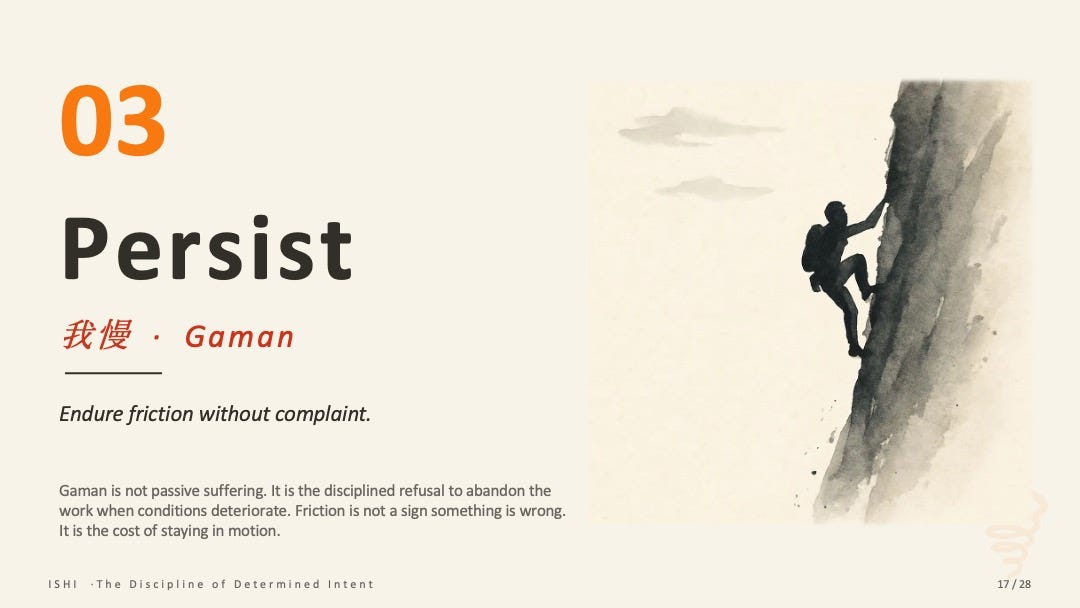
The Persist phase of the Ishi Spiral, which in Japanese is Gaman, takes over when refinement reaches diminishing returns and the work stops being about improvement and starts being about exposure. Shugyo asks whether your form is correct. Gaman asks whether that form can be held when fatigue, monotony and doubt apply pressure. The 2 disciplines continue together, and the Spiral turns when each knows when to yield authority to the other. Under prolonged load, awareness degrades before effort does, and the ability to tell strain from harm weakens exactly when you need it most. Holding awareness intact while the work continues is the assignment.
Gaman is written 我慢. Ga (我) refers to the self, the seat of awareness and agency. Man (慢) conveys slowness, restraint and bearing over time. Together the characters describe a self that restrains impulse and endures without collapsing inwards or spilling outwards. The etymology has a complication. In its original Buddhist usage 我慢 meant pride, the conceit of a self that believes itself permanent and central, and over centuries Japanese usage inverted a vice to be dissolved into a virtue to be cultivated. Both meanings survive: the arrogance of believing you can endure anything, and the discipline of enduring what you have consciously chosen to bear.
That line runs straight through this issue, because persistence fails on 2 sides. We stop too early, before practice has had time to compound. Or we continue too long, after the conditions that justified the effort have changed. The first gets explained as weakness and the second gets praised as dedication. Both are failures of governance, a missing mechanism for deciding whether endurance is still serving its purpose. I have a story from each side.
The first is the Kiwiman Double XTri in 2021, 2 longer-than-Ironman distances on consecutive days over the same Taranaki terrain, with only 2 of us committed, Paul Voorend and me. Day one ended after 14 hours of swimming cycling and running, the run cut short by a storm, with me 5 minutes behind Paul. Day 2 began with the question endurance athletes fear most. Can this be done again, in the same tired body, with a mind that now has proof of pain?
Trying to stand after the second swim dropped me to all fours, and Thiri and my business partner Horia hauled me upright. The first hour on the bike was grim. Power numbers meant nothing, heart rate stayed stubbornly low and every sensation compelled me to stop while every rationalisation made sense. I cried. Then I thought of my book, and abandoning mid-course while writing on self-governance was a cost I was not prepared to pay. It felt contractual rather than heroic. I kept turning the pedals because forward was the only acceptable direction.
What got me through the rest of the day was small rules rather than big motivations. Eat on schedule. Treat the Morton’s neuroma burning under my forefeet as a signal requiring adjustment rather than philosophy. Paul caught me near the end and we walked the last stretch together, because racing had stopped being the point. The finish line was tape between cones in the rain. All day the signal had been discomfort rather than damage, and the load was chosen, so holding was legitimate.
The other side of the phase found me in 2014, and it ended without any tape. That year I raced Ironman New Zealand in March and Ironman Cairns in June, with 3 half Ironman races alongside. Then I flew to Edmonton for the ITU World Championships and entered the Olympic distance, the sprint and the aquathlon, because the races were there and because I could. The following week I flew on to Switzerland to race Powerman Zofingen.
I finished that block with personal bests in Edmonton and Zofingen, then went straight into a club training camp with my coach, Stephen Farrell, and felt flat the entire week. Just empty, neither sore nor injured. I developed shingles 2 weeks later. Shingles tends to appear when the immune system has been suppressed for a sustained period, and mine had been, because alongside the racing I was consulting at a bank in Auckland and helping run our farm 2 hours north, with dozens of animals to care for whenever Thiri was on shift at the hospital. I pulled out of the Coast to Coast Longest Day and did not race for almost a year. For months I was on Tramadol, and it barely scratched the surface of the pain.
Steve told me to stand in front of the mirror and ask myself why this had happened. He was uninterested in the virus. He wanted me to explain the conditions that let it take hold. Nothing went wrong suddenly. I had stacked demand onto a system with no enforced recovery and no permission to stop. I was fixated on qualifying for Kona outright and I suppressed every signal that argued for restraint. I was run-down rather than broken down, and the difference counts, because run-down is gradual and nearly invisible from the inside. I was the boiling frog. I had discipline without self-governance, and eventually my body enforced the Abort my judgement refused to make.
Put the 2 stories side by side and the surface behaviour looks identical. A tired body, loud signals, a mind overruled. What separated the 2 was settled long before the hardest hours. At Kiwiman, persistence drew its legitimacy from a prior decision with a defined scope, a horizon and an accepted cost. In 2014 there was no governing decision at all, only accumulation, and the signals crossed into damage unread. Persistence amplifies whatever it is given. Governed, it produced one of the most honest days of my racing life. Ungoverned, it took a season, and it was patient enough to have taken more.
Gaman is decided in advance and bounded in time for exactly that reason. Persistence holds authority only for a defined period, and then authority returns to reflection. The mechanism that governs the moment itself is AHA: Adjust, Hold, Abort. Its conditions are set back in the Decide phase while judgement is clear, because by the time you need it, reasoning has already degraded. The measure of Gaman is whether you remained the authority over your own effort while you endured. Endurance alone proves nothing.
So here is the practice for this week, and it asks for less time than reading this issue. Take the commitment you named in the Decide phase and execute inside its boundary without renegotiating the decision mid-cycle. Write 2 rules. The first is an endurance rule, the minimum standard that still counts on a low-energy day. The second is a stop rule, the condition under which you must pause and reassess rather than push through. At the end of each day ask a single question: did persistence stay inside bounds, or did it become negotiation, drift or ego?
Next week: Reflect, or Hansei. Endurance preserves capacity only when it ends on schedule. What happens once the load lifts decides whether any of it becomes learning rather than legend.
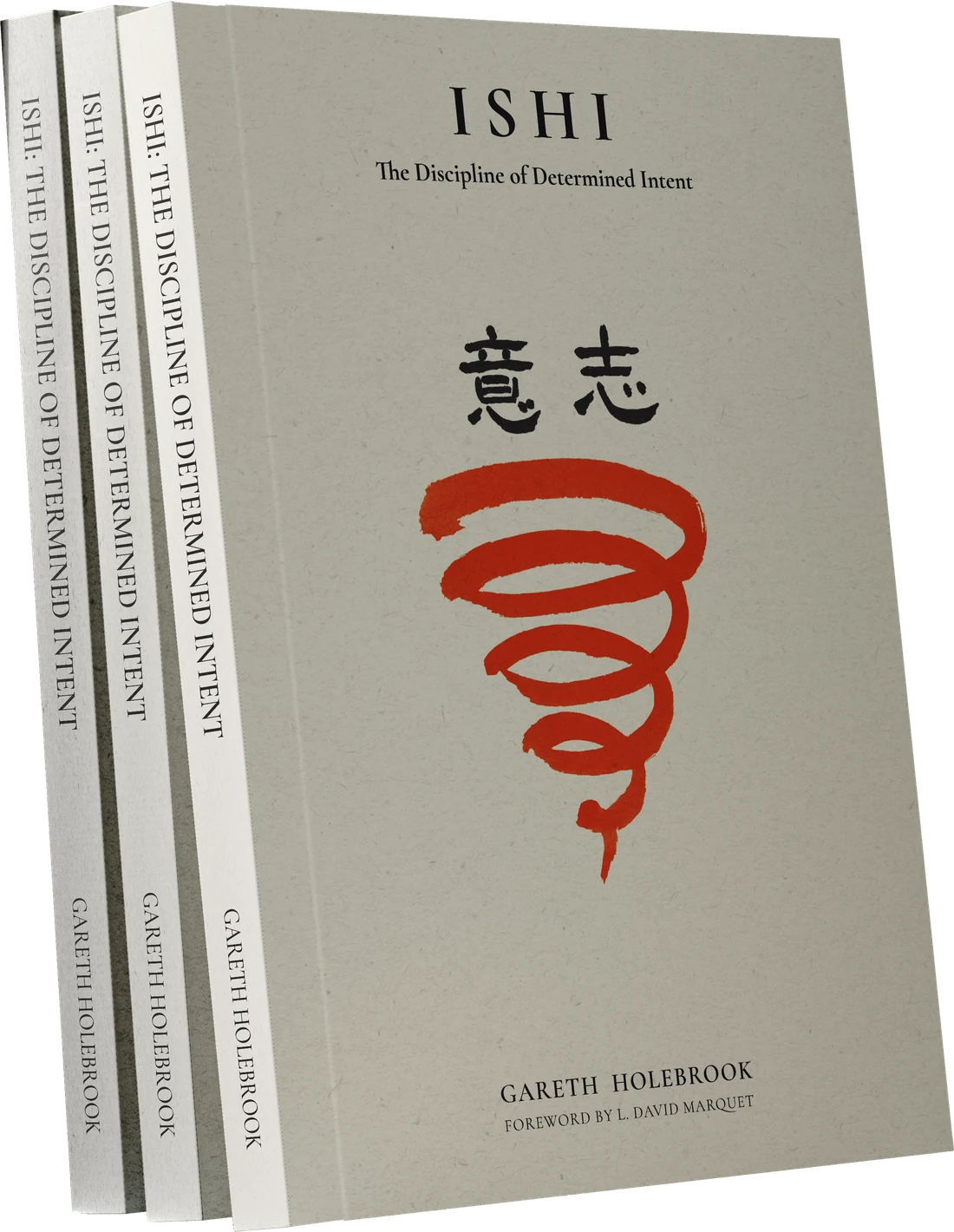
The full architecture of the Persist phase is in my book, Ishi: The Discipline of Determined Intent. The research behind it, the failure studies and the tools that make it operational are all there.
It is on Amazon, in paperback and Kindle, at https://www.amazon.com/dp/1067285512.
First published on Substack: read Weekly Ishi 9: Gaman on Substack.