Weekly Ishi 23 July 2026
Weekly Ishi 6: The Ishi Spiral
How the parts fit into one shape, before the phase-by-phase walk.

So far I have identified the problem and described the parts: a card you can fill in before a hard thing and the case for choosing the hard thing in the first place.
This issue steps back and articulates whole structure that those parts belong to. Everything I write, and everything in my book, hangs off the Ishi Spiral.
The Ishi Spiral has 4 phases:
Decide, which in Japanese I name Ishi, sets the commitment, its horizon and the conditions under which it ends.
Forge, Shugyo, turns that commitment into capability through bounded, corrected, repeated practice. Persist,
Persist or Gaman, holds effort steady under fatigue and doubt, with the escape conditions, (Adjust, Hold, Abort) already declared before judgement degrades.
Reflect, Hansei, examines the whole attempt without defence and delivers a verdict: recommit, pivot or release. Then the Spiral turns, and the next decision is made by a wiser version of you.
You can read it 3 ways, and all are true. Read it as a sequence to learn it and as a concurrent system to use it, because in real life the phases run together and feed one another. Read it as a sequence of authority to self-govern as only one phase holds the deciding vote at any moment. The phases are coupled as well as chained, and the original decision stays alive as a governing boundary through everything that follows.
It would be reasonable to assume the spiral is continuously balanced, however in practice it is never balanced for long. Intent drifts and practice deteriorates. Endurance either dissipates into quitting or hardens into identity. The Spiral behaves as an adaptive system, and it works because its internal forces are deliberately kept in balance, never because the steps were followed in order. When one phase starts to dominate, the structure deforms, and the deformation shows up in your life as fatigue, noise, loss of meaning or stalled progress.
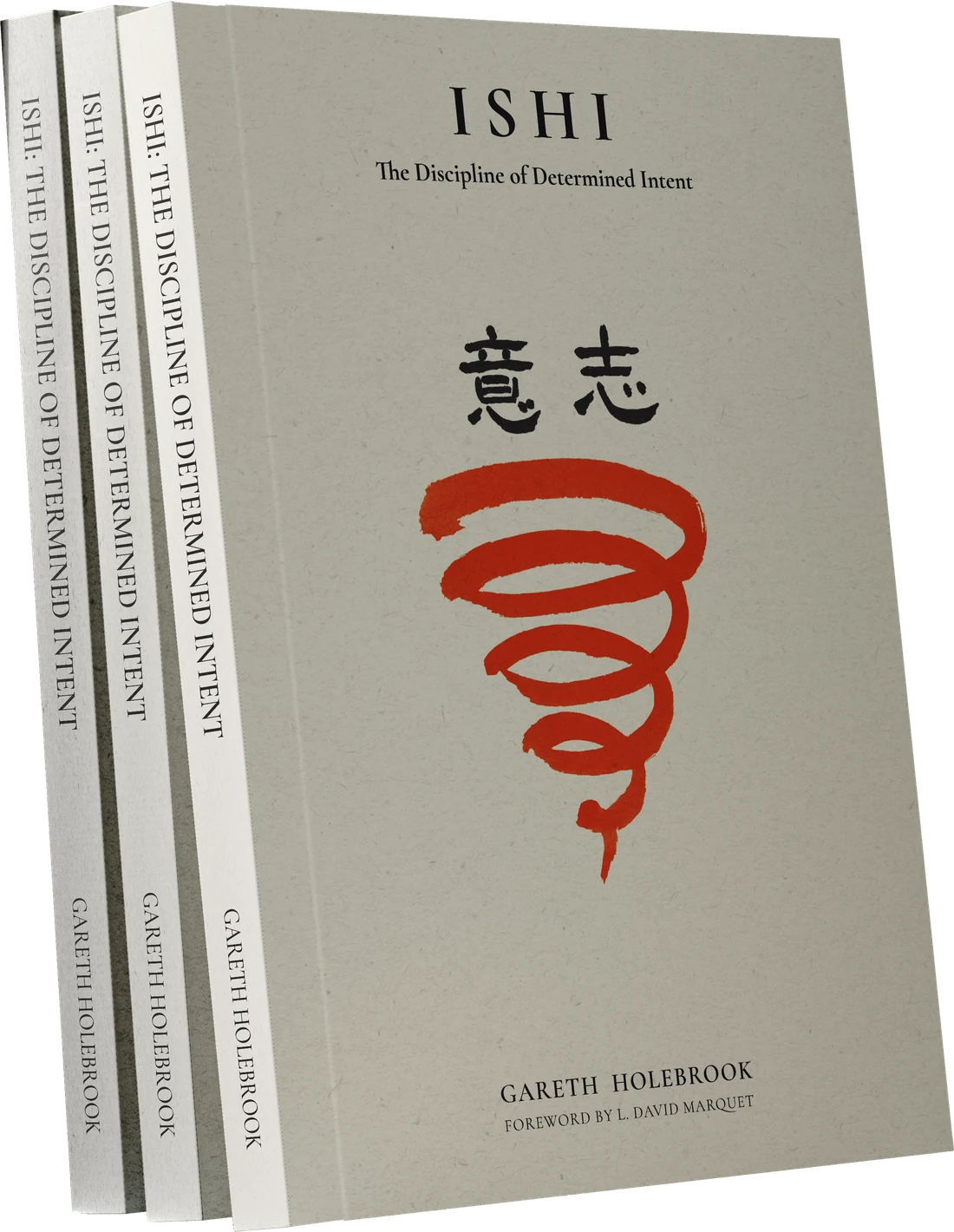
Gaman overstays its welcome and holding on replaces learning. Hansei can fail in the opposite direction, where insight accumulates and action stalls. These are structural imbalances, and the remedy is attention rather than force: reintroduce the neglected phase and rotation resumes. In my book, Ishi: The Discipline of Determined Intent, I compress the 2 most cognitively dense chapters into a pair of principles. Movement creates stability while relationships create integrity.
Integrity is an expression of the relationships between the phases, and each pairing does specific work. Ishi authorises movement; Hansei reclaims that authority when conditions change. Without Hansei, Ishi hardens into defence. Without Ishi, Hansei becomes abstract commentary. Ishi gives Shugyo its point, and Shugyo reciprocates with evidence, revealing where the friction actually lives and what the decision underestimated. Gaman draws from both ends: a reason to endure from Ishi, and a seat at the table for Hansei so that pain tolerance never replaces judgement.
There is one more coupling. A chosen direction filters your attention, which is useful for focus and dangerous for evidence. Hansei deliberately breaks that filter and forces you to look at what you have been ignoring.
Authority moves around the Spiral, and this alternation is what holds the whole thing together. I owe the language here to L. David Marquet, whose redwork and bluework describe the 2 modes of all work: execution, and thinking about execution. Decide and Reflect are bluework, where sense is made and authority is exercised. Forge and Persist are redwork, where effort meets reality, with awareness kept alive so persistence never slides into escalation of commitment.
A common failure mode I observe at work is when we get locked into either redwork or bluework. Either the doing runs continuously until meaning erodes, or the thinking refines itself forever while reality moves on. The Spiral is a controlled oscillation between the two, and the only real choice is whether you move between redwork and bluework consciously or allow circumstance to decide.
My book pushes this one level deeper, into the part I find most useful under load. The Spiral runs as governance and as operation at the same time. Governance is episodic, explicit and decisive: the commitment, the horizon, the exit conditions, set at defined moments and closed. Operation is continuous and adaptive: the thousand small corrections that keep the effort alive inside those boundaries. In an Ironman swim the governing decisions are fixed before I enter the water, the course, the target pace, the energy budget. Inside those boundaries I adjust constantly, the line around a buoy, the breathing pattern, the catch. The governing rule of the whole discipline is that operational modes act and observe within the boundaries, and governing modes decide and redesign only at defined moments. When that separation breaks down, the Spiral loses structure and becomes noise.
This structure brings risk as well as power. Determined intent is kinetic force. It magnifies direction, and when the direction is flawed, damage compounds before it becomes visible. The Spiral fails in 2 predictable ways: persistence pushed past its written conditions until it turns unsafe, and intent eroding while action continues on inertia, a pattern I call stealth drift, which preserves the appearance of discipline while hollowing out its core. I have lived both failures, on the race course and in business, and the case studies in my book walk through what each one cost. The guardrails that prevent both are built into the discipline, and the Ishi Card you met 2 issues ago is the smallest of those guardrails, small enough to write in 30 seconds.
Over the next 4 issues I will explain each phase. Decide, and the 4 ways deciding fails. Forge, and a practice that looked perfect and was not. Persist, and the persistence that cost me a business. Reflect, and the audit without defence. One phase a week, each with its tool and a worked case.
This issue is the map. The territory, the full mechanics of stability and integrity, the failure studies, and the 17 operational tools that make the Spiral usable is my book, Ishi: The Discipline of Determined Intent.
It is on Amazon, in paperback and Kindle, at https://www.amazon.com/dp/1067285512
First published on Substack: read Weekly Ishi 6: The Ishi Spiral on Substack.