Weekly Ishi 30 July 2026
Weekly Ishi 7: Ishi, the Decide Phase
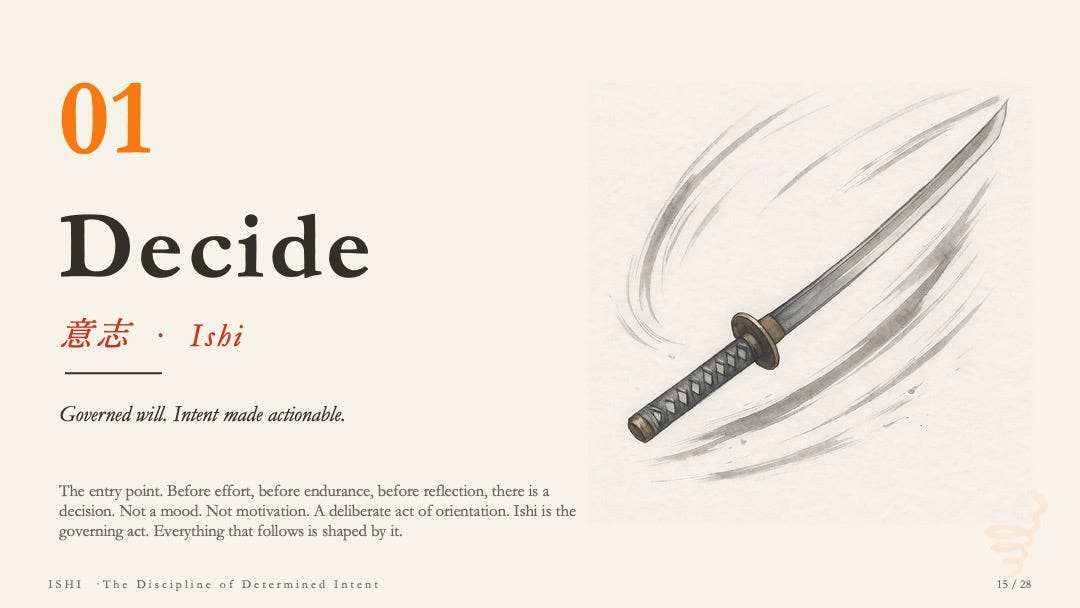
Last week I laid out the whole shape of the Ishi Spiral and now I am going to go through in more detail, one phase at a time. Decide (Ishi) is the crucial start point. Everything downstream inherits its quality. When the decision is sound, practice has a point, endurance has a reason and reflection has a baseline to measure against. When the decision is vague, borrowed or unstable, there will be degradation in the forging, the persistence and reflection that follows.
This is the problem that the Ishi phase aims to resolve. The origin of failure precedes effort, willpower or discipline. It is unclear commitment. Action without a settled direction looks busy and produces nothing durable. Endurance without a clear decision becomes noise. Reflection without a firm starting point becomes rumination. Ishi is the phase that stops motion turning into self-deception or blind continuance.
The word ‘decide’ comes from the Latin decidere, to cut, to discern. Ishi resolves the competing wills that we can all hold into a single governing direction that holds for a defined period. Until that cut is made, intent remains aspirational, broad and ambiguous. Once it is made, the focus of attention narrows and the internal conflict resolves.
A real decision does 4 things, and each one shows up as a field on the card I published 3 issues ago. The first is explicitness. A decision is named and bounded, and it answers 3 questions precisely: what am I committing to, why now, and how long does this stand before review. Leave any of those implicit and drift moves in.
The second is cost acceptance. Ishi involves loss, because choosing one direction means declining others: time, energy, reputation, optionality. When you say yes to one thing you necessarily say no to many others.
The third is temporal authority. A decision without a horizon cannot be governed. The horizon protects the commitment by preventing renegotiation mid-effort, and protects your judgement by creating a fixed point where reconsideration is required.
The fourth is ownership. A decision cannot be delegated. Advice can influence it and data can inform it, but responsibility lies with one person who bears the consequence of being wrong. Ownership also means naming the conditions under which the commitment is no longer valid, which is the difference between governed persistence and stubbornness.
I draw evidence for these claims from Peter Gollwitzer’s work on implementation intentions. Across studies from 1999 onward, he found that abstract goals produce negligible behaviour change while specific if-then commitments roughly double follow-through. A written commitment moves the decision out of the moment of action, where fatigue, distraction and competing demands degrade judgement, and into a prior, calmer context. The decision is made once, under low load, and then held. That is exactly what the card does, and it is why 30 seconds of writing outperforms a week of good intentions.
Now the part I find harder to write, because Decide governs stopping as well as starting. I first raced the Coast to Coast in 2005, and I told that story in a recent podcast episode, so I will not retell it here. What counts for this issue is what happened 20 years later. I entered the 2026 race soon after I was defeated in 2025, missing the final cut-off by a mere 5 minutes after 13 hours on the course. I entered with something close to defiance and definitely an element of stubbornness.
Then, in October last year, my position was clear: my book had to be finished, and preparing properly for the Longest Day after a substandard World Championships would have put it at real risk. So I spoke with the organisers, deferred my entry, and secured a place for 2027 instead. That deferral is an example of Ishi. It is a conscious decision about what not to do, made explicit, held over time, and revisited honestly when conditions changed. My Ishi was the completion of my book. Call it governance rather than courage. It cost me something I wanted, which is how I know it was a sound decision.
Deciding fails in 4 recognisable ways, and every one is socially acceptable, which is what makes each one dangerous. Borrowed intent is the first. The goal comes pre-packaged from culture, peers, a career ladder or identity repair. It sounds right and looks respectable, and it collapses under real pressure, because it was never yours.
Premature execution is the second. You move before the decision has settled, because activity creates the feeling of progress. The harder work of choosing gets avoided while you look productive.
Decision by accumulation is the third, and it is the one I see most often in the people I coach. Many small yeses stack up without a governing no. Each one is reasonable alone. Added together the stack consumes your capacity, and you wake up overcommitted with no memory of having agreed to it.
Emotional capture is the fourth. Decisions made in anger, fear, pride or urgency feel powerful, and the clarity is real but narrow. When the emotional state passes, the intent dissolves with it. My 2026 entry, made in defiance days after the race beat me, was closer to this than I would like to admit. The deferral was the correction.
All 4 have one cause: authority was never established clearly or bounded honestly. So here is the practice, and it takes less time than reading this issue. Choose one commitment you will govern for the next 24 hours. Write one sentence naming it, add the horizon, add one boundary, and add one trigger that would make you adjust, hold or abort. Then name one explicit exclusion, the thing you will not do inside that horizon. At the end of the horizon, ask 2 questions. Did I stay in bounds, and did the boundary or the trigger fire?
Next week: Forge. We need to act our way to new thinking. A decision that stays internal decays, because the mind moves on and old habits take back control. Intent only becomes real when it reshapes behaviour, and that translation is practice, in the form the Japanese call Shugyo.
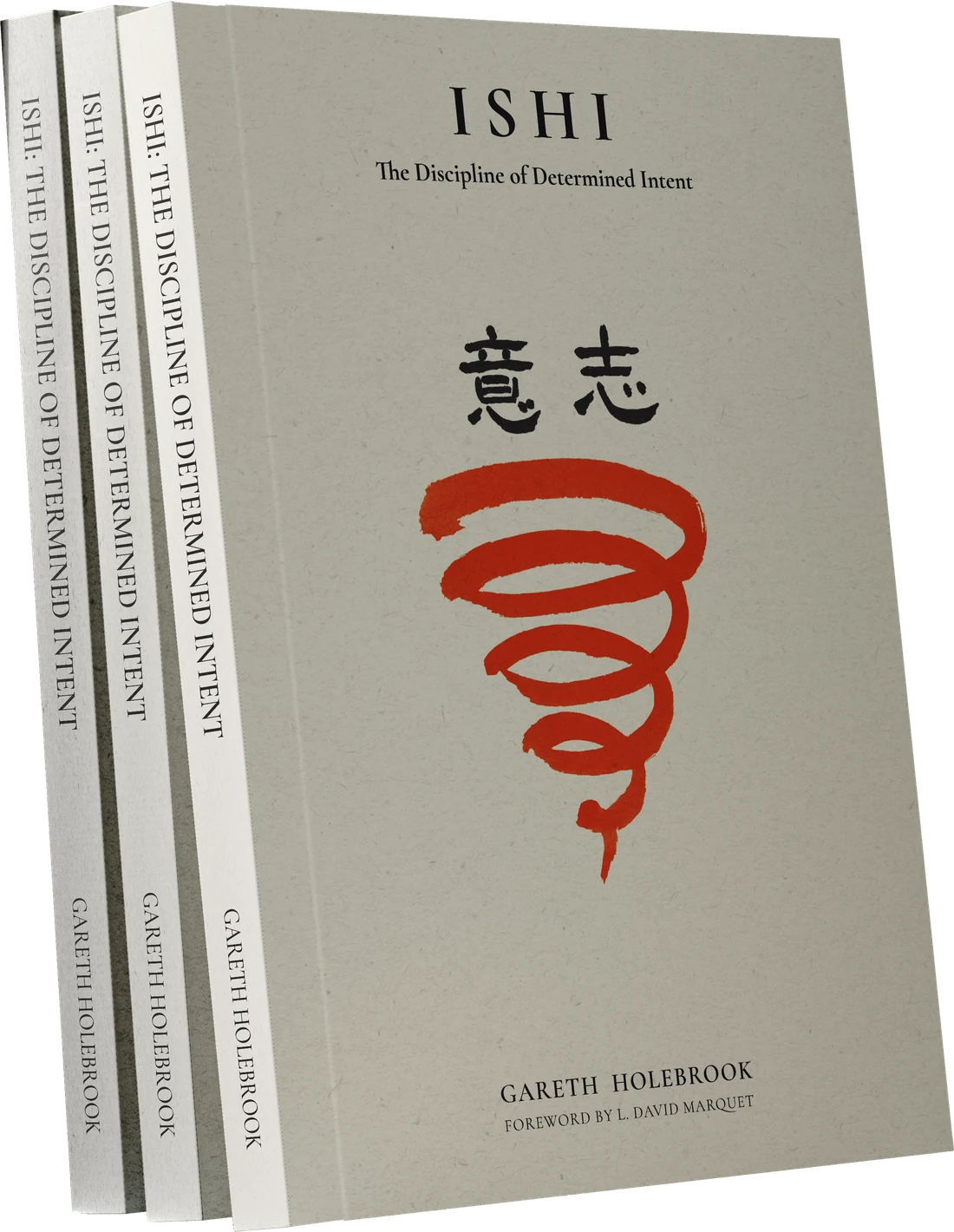
The full architecture of the Decide phase is in my book, Ishi: The Discipline of Determined Intent, along with the research behind it, the failure studies and the tools that make it operational. It is on Amazon, in paperback and Kindle, at https://www.amazon.com/dp/1067285512.
First published on Substack: read Weekly Ishi 7: Ishi, the Decide Phase on Substack.