Weekly Ishi 7 August 2026
Weekly Ishi 8: The Forge Phase
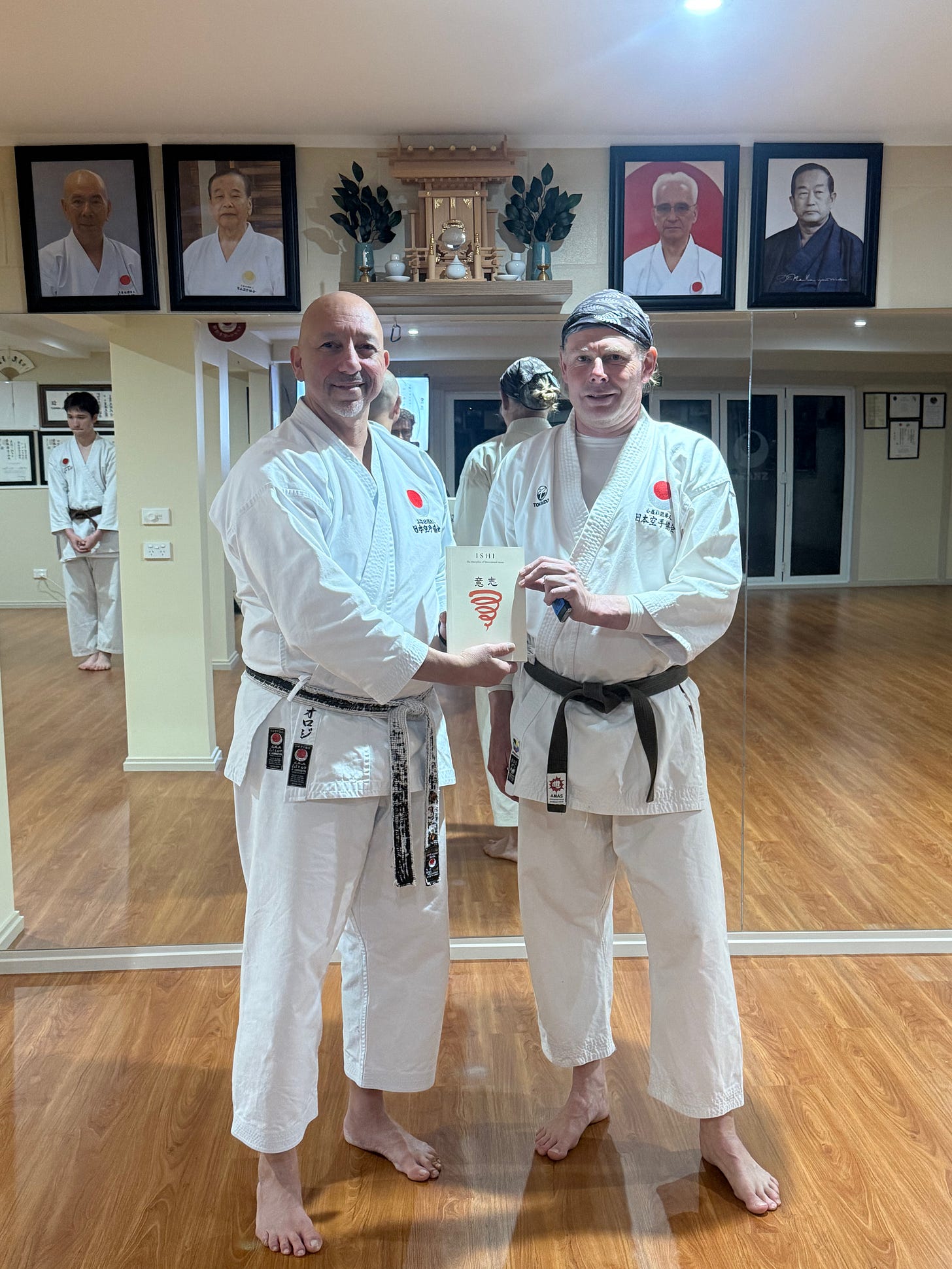
Last night I was back at the dojo for the first time in a while. Travel and work outside Auckland have made it hard to get there, and the first session back is always an honest one. I offered Sensei Karl Naoroji a copy of my book, because he appears throughout the chapter on the Forge phase and on my practice of kata.
Sensei Naoroji is a 7th-dan Shotokan instructor with more than 45 years of practice behind him. He is precise, demanding and intolerant of sloppiness. Corrections are immediate and specific. Foot angle, hip rotation, timing, breath. If something is wrong it is corrected until it is no longer wrong, and no workaround is available to you. That is the phase in a paragraph.
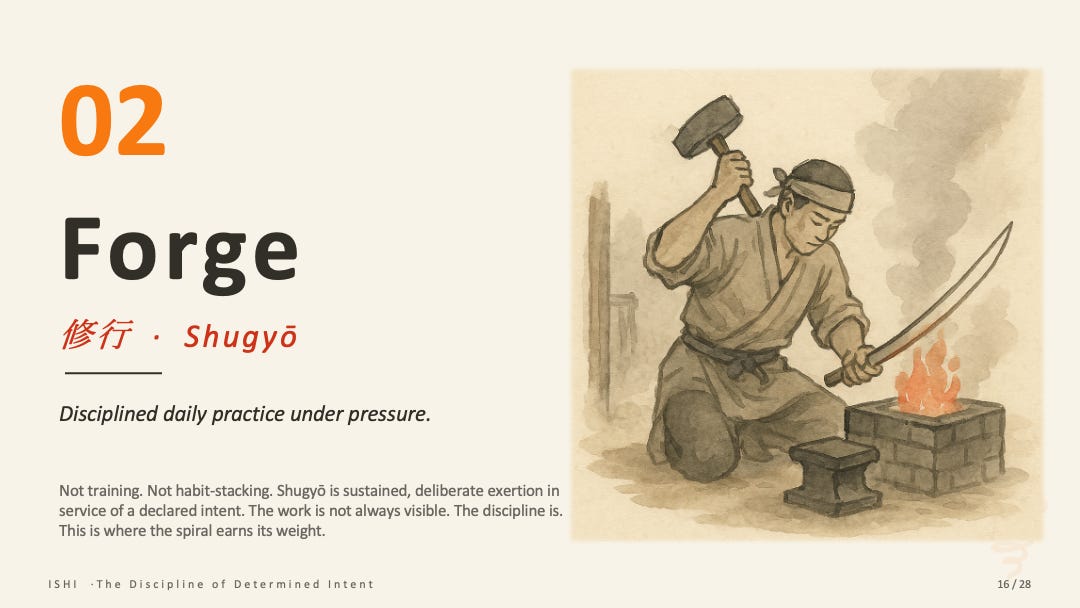
Last week I wrote that we need to act our way to new thinking. Forge, which in Japanese I name Shugyo, is where that happens. Ishi governs commitment and Shugyo governs embodiment. It is how intent moves out of the head and into the body, and without it a decision stays a private opinion about the future.
修 (shu) means to polish, to refine, to discipline. 行 (gyo) means to act, to move, to walk a path. Read together, the word describes refinement through action, and the emphasis falls on removing what does not belong until form is precise enough to hold intent without distortion. Shugyo asks for less, done better.
Here is the failure the phase resolves. Repetition gets confused with practice because repetition feels productive, and doing the same thing again creates closure even when nothing is being refined. Without precision, feedback and correction, repetition stabilises whatever pattern is already present. The body does not discriminate. It learns exactly what you ask it to repeat, errors included.
Karate breaks into 3 practices. Kihon are the fundamental strikes, blocks and kicks, repeated endlessly with stance, transition and breathing observed and corrected. Kumite is controlled sparring, precision under pressure. Kata are formalised sequences, 26 in Shotokan, ranging between 28 and 62 movements, and each one is compressed combat logic rather than choreography, so practised slowly it rewires movement. Structure precedes freedom.
We borrowed the word for business. Mike Rother studied Toyota and published Toyota Kata in 2009, arguing that the company’s real advantage lay in its routines of thinking rather than in the visible tools everyone else was busy copying. His Improvement Kata runs in 4 steps: understand the direction, grasp the current condition, establish the next target condition, then run experiments towards it. The Coaching Kata is the set of 5 questions a coach asks so that the learner does the thinking. We use kata in business as a metaphor and it is directly applicable, because the mechanism is identical.
The research deserves care here, because it is the most misquoted finding in the field. In 1993 Anders Ericsson, Ralf Krampe and Clemens Tesch-Römer studied violin students at a Berlin music academy and found that the most accomplished had accumulated an average of around 10,000 hours by the age of 20. Malcolm Gladwell turned that average into a rule in Outliers. Ericsson spent years correcting him, calling it a provocative generalisation: an average rather than a threshold, with roughly half that elite group under the headline number at 20, and the variable he cared about was the structure of the practice rather than the total.
In Peak, written with Robert Pool in 2016, he set the conditions plainly. Focused attention, external feedback and deliberate correction at the edge of your current ability. Hours alone change nothing, which is why the dojo works and why undirected volume does not. In fairness to the critics, Ericsson’s strong claim has been challenged, and Macnamara and colleagues found in 2014 and 2016 that deliberate practice explains a significant but incomplete share of performance variance. Shugyo rests on the weaker claim that no side disputes: constrained, intentional repetition with feedback beats undirected volume.
There is a cost to all this and I have paid it in public. I returned to karate a few months after finishing Kona in 2022 and my endurance numbers have dipped since, and hip mobility remains a constant battle in your 6th decade. Through 2025, as I worked towards shodan, my training volume dropped further, and that trade-off was deliberate, because Shugyo prioritises refinement over fitness. Stephen Farrell, head coach at the North Harbour Triathlon Club for 30 years, puts it better than most definitions manage: do not practise until you get it right, practise until you cannot get it wrong.
Forging fails in 4 ways, and every one looks like diligence from the outside. Repetition masquerading as practice is the first. Hours accumulate, routines feel productive and capability plateaus, and the absence of visible failure lets that state run for years.
Familiarity decay is the second. As fluency increases, scrutiny decreases and small errors persist unchecked until correction starts to feel like regression. Experienced practitioners drift further than beginners for exactly this reason, and I include myself in that.
Effort substitution is the third. When correction threatens your sense of competence, intensity replaces precision. Volume goes up, sessions get longer and fatigue becomes the proof of commitment, while the original flaw stays where you left it.
Refinement without exposure is the fourth. Form gets polished indefinitely and never tested under load. Skill that has never met real conditions stays fragile however elegant it looks, which is why Forge has to hand over to Persist.
So here is the practice for this week, and it takes 20 minutes at most. Run one deliberate rep aimed at correcting a single specific error, and before you start, write down what good looks like and name one feedback source: a metric, a coach, a video, a checklist. Choose one constraint that forces form over volume: cap the time, slow the movement or strip out the intensity. Afterwards record one observable delta: what improved, what degraded and what you will adjust tomorrow.
Next week: Persist, or Gaman. That is where form meets fatigue, and it comes with a warning worth holding in advance. Gaman multiplies whatever you hand it, good form and bad form alike, and that is why this week’s work is worth doing properly.
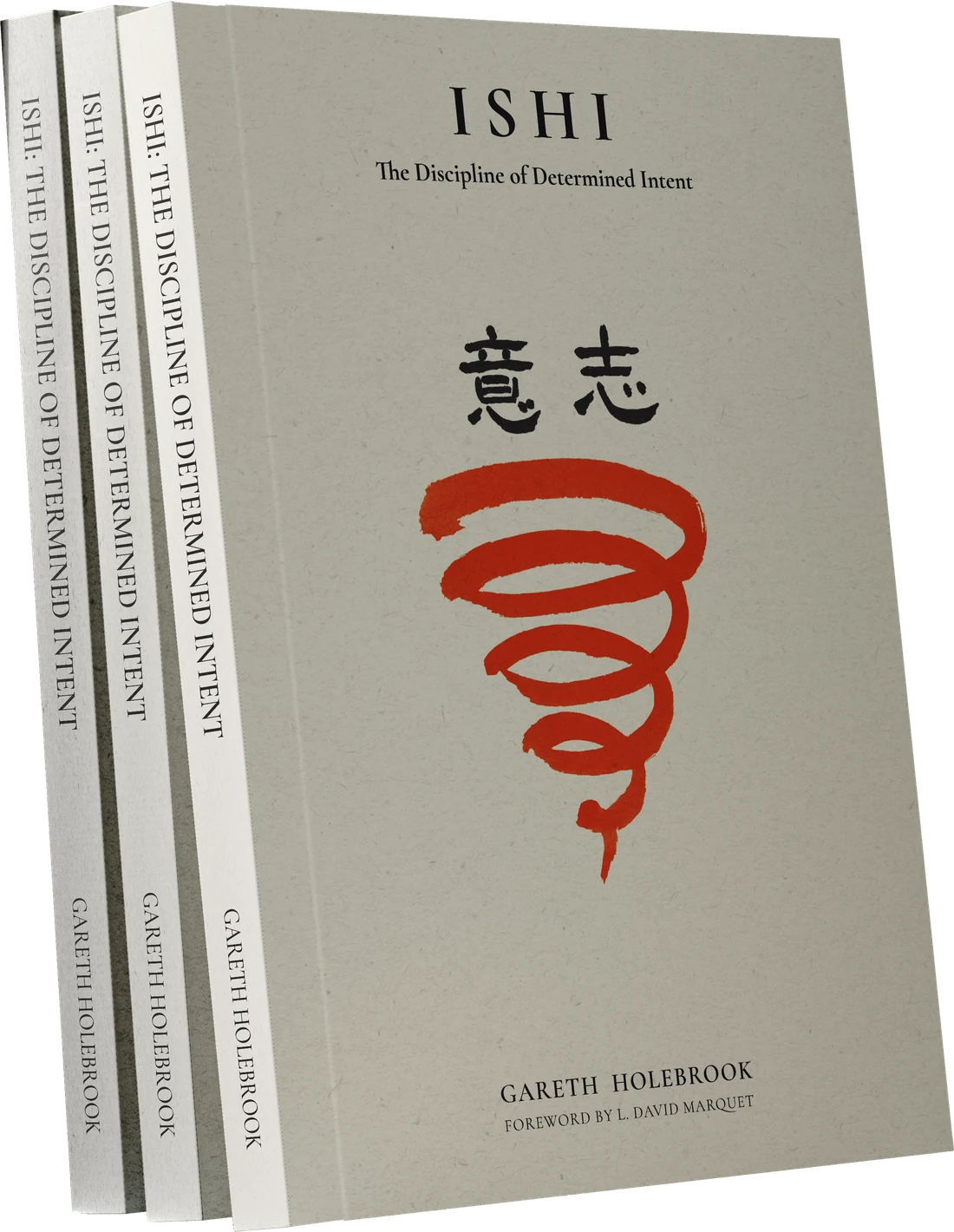
The full architecture of the Forge phase is in my book, Ishi: The Discipline of Determined Intent, along with the research behind it, the failure studies and the tools that make it operational. It is on Amazon, in paperback and Kindle, at https://www.amazon.com/dp/1067285512
First published on Substack: read Weekly Ishi 8: The Forge Phase on Substack.